About Wing Tai Properties
Wing Tai Properties Limited (“WTP”) is principally involved in property development and investment in Hong Kong. Listed since 1991 on the Hong Kong Stock Exchange (“HKEX”), the property developer commanded a market capitalisation of HKD6.52 billion at market close yesterday.
Since listing, WTP has developed over 7.5m square feet (“sq ft”) of properties under the “Wing Tai Asia” brand. The company operates under the “Lanson Place” brand for its hospitality management business. WTP delivers premium developments with a focus on design and craftsmanship, building homes that exude style and elegance.
The founding Cheng family members remained as key persons leading the group. Dr Cheng Wai Chee and his brother Mr Cheng Wai Sun sit on the board of directors as Chairman and Deputy Chairman and Chief Executive respectively. The brothers are also members of the nomination committee of WTP.
As at end-December 2018, the Cheng family controls around 34% shareholding in WTP via a number of holding companies. Other than the Cheng family, Sun Hung Kai Properties Limited, controlled by Hong Kong’s super-rich Kwok family, owns a substantial 13.6% of equity interest.
Four operating divisions
The group reports 4 segments, namely property development, property investment and management, hospitality investment and management, and others. The last segment of that list represents investing activities and corporate activities, including central management and administrative function. Geographically, WTP derives 86.1% of group revenue from Hong Kong.
The property investment and management and hospitality investment and management segments share a similar business nature of collecting rentals from investment properties held. These segments are differentiated by property types with the former mainly comprising of office and industrial buildings, and the latter hospitality assets like hotels and serviced apartments.
Property investment and management
WTP’s property investment and management segment contributes the most to the company’s revenue and profit. In 1H19, the segment generated HKD314.5m and HKD200.4m of revenue and profit before tax respectively, which translated to an impressive profit margin of 62.4%. The segment made up 74.2% of WTP’s total revenue of HKD423.9m in 1H19, with property development (2.8%), hospitality investment and management (16.7%) and others (6.4%) contributing the remainder.
The property investment and management segment holds approximately 1.9m sq ft of investment properties, mainly Grade A office buildings, as detailed in Table 1 below. Going further into details, we observe some portfolio and revenue concentration risks as we believe most of the segment’s profits are contributed by Landmark East and Shui Hing Centre. As at 30 Jun 19, the two properties have healthy occupancy rates of 97% and 98% respectively.
WTP’s portfolio of investment properties have an aggregate attributable fair market valuation of around HKD20.5 billion as at 30 Jun 19. 93.3% of the portfolio valuation are attributable to properties in Hong Kong, which carry land leases between 28 to 45 years, which an average remaining lease of 31.4 years. Given the current lease expiry profile of WTP’s investment property portfolio, we think it would be unsurprising if the group is considering capital recycling and growth opportunities.
Table 1: Investment properties held under the property investment and management segment (as at 31 Dec 18)
|
Property |
Gross floor area (sq ft) |
Year of lease expiry |
Effective interest (%) |
Remarks |
|
Landmark East, 100 How Ming Street, Kwun Tong, Kowloon, Hong Kong |
1,338,000 |
2047 |
100 |
Let to outside parties; 93% occupied |
|
Shui Hing Centre, 13 Sheung Yuet Road, Kowloon Bay, Kowloon, Hong Kong |
186,800 |
2047 |
100 |
Let to outside parties as workshop, canteen; 95% occupied |
|
1 Savile Row/ 7 Vigo Street London, UK |
13,900 |
Freehold |
100 |
Let to outside parties as retail and office |
|
8-12 (even) Brook Street, London, UK |
19,100 |
Freehold |
100 |
Let to outside parties as retail and office |
|
35 Berkeley Square, London, UK |
7,900 |
2139 |
100 |
Let to outside parties as office |
|
10 Fleet Place, London, UK |
191,800 |
Freehold |
25 |
Let to outside parties as retail and office |
|
3 Cavendish Square, London, UK |
13,300 |
Freehold |
33 |
Scheduled for leasing |
|
30 Gresham Street, London, UK |
403,600 |
2178 |
50 |
Let to outside parties as retail and office |
|
Source: Company |
||||
Hospitality investment and management
Other properties held for investment purposes include serviced apartments under the Lanson Place brand within WTP’s hospitality investment and management segment. Most of these luxury residences are located at prime areas. Some examples include the fully-owned Lanson Place Hotel and Waterfront Suites in Hong Kong.
The hospitality segment is another key segment of the group, generating HKD68.4m of revenue (14.6% of total revenue) in 1H19. The segment fell to a loss before taxation of HKD0.5m in 1H19, compared to HKD65.5m of profit before tax in 1H18. Nonetheless, the decline was largely due to the absence of HKD47.0m of fair-value gains on investment properties (1H19: HKD1.0m) and HKD34.2m of share of profits from joint ventures (1H19: loss of HKD11.1m) from the prior year. Management attributed the weak segment results to the softening of hotel markets, which are likely affected by the ongoing political unrest in Hong Kong.
The group also manages five service residences in Shanghai, and others in Singapore, Chengdu, and Kuala Lumpur. By 2022, the group targets to open a brand new luxury serviced residence in Melbourne. It has also recently entered into a 10-year management agreement to manage a new 400-unit serviced residence in Manila that is expected to open by 2022.
We think the segment will continue to generate a stable stream of income for the group. Profit before fair value changes and share of results from joint ventures stood at HKD18.9m in 1H19, significantly improved from a loss of HKD10.3m in the previous corresponding period, which we think were boosted by the opening of Waterfront Suites in April.
Property development
In 1H19, the property development segment recorded a revenue of HKD11.7m, down from HKD16.4m in 1H18. In contrast, profit before tax swung to a positive HKD29.3m (1H18: loss before tax of HKD68.9), thanks to HKD126.1m in share of results from joint ventures, which mainly came from more sold units of Le Cap and La Vetta handed over to buyers during the period. WTP holds an effective stake of 35% in each of the two projects.
We are not overly concerned of the lower revenue seen over 1H19 as top-line volatility is common in the property development sector, of which revenue recognition is tied to the timing of project completion and handover. WTP has a decent pipeline of projects and we expect them to support top line as they complete over time.
Two wholly-owned residential projects known as The Carmel and OMA OMA in Hong Kong together provide a saleable area of roughly 381,000 sq ft with 644 units. They are expected to complete by early 2020 and mid-2021 respectively. In addition, the group owns 70% of a 294,000 sq ft residential project adjacent to The Carmel at Castle Peak Road, Tai Lam, Tuen Mun. The project is scheduled for completion in 2022.
Meanwhile, completed joint-venture projects Le Cap and La Vetta were 28% and 25% sold (in terms of units) respectively as at 30 June 19. Continued unit sales at the two projects should support WTP’s profitability, although we expect sales to slow down for the immediate quarters ahead amid the ongoing social disorder in Hong Kong.
1H19 results highlights
Group revenue in 1H19 stood at HKD423.9m, down 9.7% YoY from HKD469.5m in 1H18, while profit before tax slashed 74.3% YoY to HKD285.4m (1H18: HKD1.07 billion). We are not too concerned over the sharp decrease in profits as it is largely due to the absence of a one-off gain of HKD693.3m from the disposal of W Square in 1H18.
Gross profit margin remained very healthy at 80.5%, up from 78.8% in 1H18. Expensive rentals in Hong Kong have helped WTP maintain a high gross profit margin. In 1H19, revenue from rental income was HKD385.6m, which yielded healthy margins after deducting HKD69.6m of direct operating expenses arising from investment properties held for generating rental income.
Meanwhile, share of results of joint ventures and associates almost doubled to HKD81.3m in 1H19 (1H18: HKD41.2m), mainly attributable to the property development business. As mentioned earlier, the segment recorded HKD126.1m in share of results from joint ventures, following the handover of more sold units at Le Cap and Le Vetta.
We estimate earnings before interest, tax, depreciation, and amortisation (“EBITDA”), excluding disposal gains, at HKD458.4m and HKD320.6m in 1H18 and 1H19 respectively. The 1H19 EBITDA was 5.1 times WTP’s interest expenses including distributions paid on perpetual capital securities, a healthy level in our opinion, despite falling from 6.7x in previous year’s corresponding period.
Credit highlights
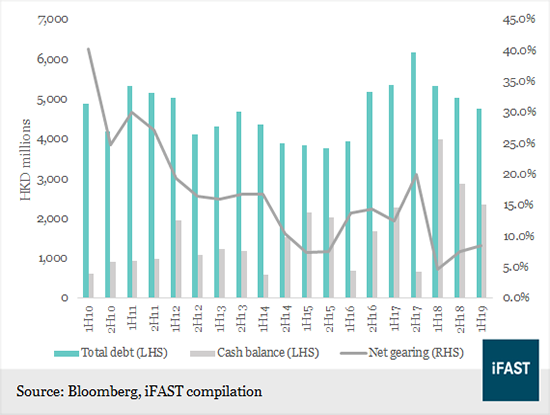
Following the repayment of HKD285.1m of borrowings in 1H19, total debt fell from HKD5.03 billion as at 4Q18 to HKD4.76 billion as at 30 Jun 19. Meanwhile, cash fell from HKD2.9 billion to HKD2.4 billion over the same period, resulting in an increased net gearing (net debt/total equity) of 8.4% (4Q18: 7.5%). Treating the S$260m WINGTA 4.350% Perpetual Corp (SGD) as debt, we find adjusted net gearing at 14.5%, up from 13.5% in 4Q18.
In addition, we note that the group had contingent liabilities of HKD8.08 billion in respect of guarantees given by the company for banking facilities granted to certain joint ventures. While the utilised amount of these bank facilities in 1H19 was undisclosed, we understand from WTP’s 2018 annual report that bank loans of some HKD6.06 billion guaranteed by the company had been drawn down by its joint ventures.as at 31 Dec 18. In the worst-case scenario assuming all of these contingent liabilities are crystallised, we find adjusted net gearing at 36.8%, still manageable in our view.
Despite the increased net gearing, the current level of net gearing is still very healthy in our opinion. Looking further back, net gearing has fell from a high of 40.3% back in June 2010 to the current level of 8.4%, which speaks well for WTP’s prudent capital management. As shown in Figure 1, WTP averaged a debt level of HKD4.70 billion over the past nine years, while cash had increased significantly in recent years as the firm slowed down its pace of land acquisitions.
Figure 1: Net gearing has fallen since FY10
Cash generated from operating activities (“CFO”) swung to positive HKD312.7m in 1H19 from negative HKD348.8m a year ago, despite the deteriorated bottom line. Moreover, the current ratio at 2.5x denotes decent working capital management.
WTP has a comfortable liquidity position with its HKD1.03 billion of short-term debt well covered by HKD2.35 billion of cash as at 30 Jun 19. We expect liquidity to be boosted further as the group records HKD293.0m of sales proceeds held in stakeholders’ accounts, which should be received in the near term. However, debt maturity is concentrated over the next few years, when WTP has to repay HKD3.44 billion by June 2024 (excluding short-term debt), representing 72% of its total debt.
That said, we believe WTP should have little difficulty meeting its debt obligations given its low gearing, sizeable tangible asset base, and access to liquidity sources. As at 30 Jun 19, the group has HKD20.63 billion of investment properties and a total of HKD1.41 billion of financial investments, which comprises mainly of corporate bonds, certificate of deposits, shares in SGX-listed Suntec REIT, and money market funds. Besides, WTP has undrawn revolving loan facilities of HKD2.43 billion. Finally, WTP’s debt-to-asset ratio is strong at 13.2% (4Q18: 14.2%).
Key risks
In line with the disposal of Winner Godown Building and W Square in 1H18, operating income from the property investment and management and hospitality investment and management segments fell to HKD278.6m in 1H19, way below the average of HKD1.50 billion between 2014 and 2018. It is important to monitor whether the weakening results from WTP’s recurring income businesses is a long-term trend or just a blip due to the company’s capital recycling plan.
We also observed some concentration risks in Landmark East and Shui Hing Centre, as we estimated that these two properties together contributed more than 90% of revenue from the property investment and management segment. Both properties are commercial properties that have remaining land leases of around 28 years, and we think the two properties have entered into a matured phase with low rental yields. By our estimates, the property investment and management segment yielded just slightly above 2% return on assets (“ROA”, annualised) in 1H19. Furthermore, Bloomberg data up to the second half of 2009 indicates that WTP’s ROA and return on invested capital are at their lowest level, coming in at 1.55% and 1.10% respectively in the trailing twelve months to June (“TTM 1H19”).
WTP’s low profitability is translated to high debt-to-EBITDA and debt-to-CFO ratios of about 7x and 15x respectively in TTM 1H19. We think these ratios indicate that WTP’s present rate of operating cash flow is unlikely to suffice for meeting debt obligations as they come due. Nonetheless, we take comfort from WTP’s asset-rich balance sheet and low refinancing risk.
Last but not least, Hong Kong’s sky-high property prices set the risks of a dangerous bubble, although cooling measures and the ongoing social unrest have helped to let some air out. We think WTP has the financial holding power to delay project launches if need be. In addition, the group’s healthy balance sheet should support it to ride through a market downcycle should it happen.
Business outlook
We like WTP’s conservative management philosophy. Unlike many other property developers that have been aggressive in their land purchases, WTP has over the years focused on building a stable recurring income source, while staying prudently active in growing land reserves when opportunities arise.
In the near term, the group will likely be occupied with the development of its current projects The Carmel, OMA OMA, and Castle Peak Road. All three projects achieved good progress.
As at 30 Jun 19, 78% of 178 residential units in The Carmel are sold, and the project is scheduled for completion by early 2020. As at 28 Aug 19, 50% of 466 residential units in OMA OMA are sold and the group expects to complete the project in 2021. In 2022, the group expects to complete a residential project on a site adjacent to The Carmel, where foundation and site formation works are in progress. We like the decent pipeline of projects as they suggest a good earnings visibility in the near-to-medium term.
We prefer the WINGTA 4.25% ’22s
In light of WTP’s decent credit profile backed by low refinancing risk and strong asset base, we remain confident on the company’s debt servicing capability. The S$170m WINGTA 4.250% 29Nov2022 Corp (SGD) carries an ask YTM of 3.31% (Z-spread: 186bps). The notes look attractive relative to the WINGTA 4.500% 26Sep2022 Corp (SGD) of Wing Tai Holdings Ltd (“WTH”), the Singapore-listed controlling shareholder of WTP (effective interest of around 33%).
The WINGTA 4.5% ‘22s have an ask YTM of 2.93% (Z-spread: 148bps). We think the 38bps yield spread between the two bonds represent a generous compensation for the two-month longer maturity of the WINGTA 4.25% ‘22s.
Most of WTP’s HKD-denominated bonds look less attractive against the WINGTA 4.25% ’22s. The company’s HKD notes offer YTMs ranging from 2.32% to 3.15% in SGD terms (on a post-swap basis), with about 1.9 to 5.2 years to maturity. Interestingly, the HKD100m WINGTA 4.300% 09Aug2021 Corp (HKD) with its ask YTM of 3.15% looks attractive compared to its near dated WINGTA 4.1 Oct’21s (ask YTM: 2.32%).
The WINGTA 4.25% ’22s also offer better value against Wheelock and Company Limited’s WHEELK 4.500% 02Sep2021 Corp (SGD), which has an ask YTM of 2.53% (Z-spread: 105bps). Wheelock & Co is a HKEX-listed property group principally involved in property development and investments in Hong Kong. We think the 78bps yield pick-up on the WINGTA 4.25% ‘22s pays well for their ~1-year longer tenor and WTP’s smaller scale. As at 30 Jun 19, Wheelock & Co has total assets of HKD614.0 billion.
As shown in Figure 2, the WTP curve lies above those of Wheelock & Co, The Wharf (Holdings) Limited (WHARF) and Henderson Land Development Company Limited (HENLND), offering decent yield pickups as compensation for WTPs smaller size. In fact, WTP is less leveraged than WTH, Wheelock & Co and Henderson Land (see Table 2).
Figure 2: Relative valuation
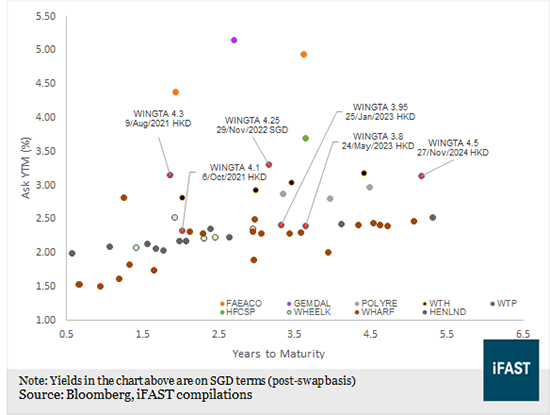
Table 2: Comparison of financial metrics
|
Company |
Market Cap (HKD billions) |
Total Assets (HKD billions) |
Debt over Assets (%) |
Net Debt over Equity (%) |
|
Wing Tai Properties |
6.5 |
36.0 |
13.2 |
8.4 |
|
Wing Tai Holdings* |
1.6 |
4.4 |
14.4 |
11.4 |
|
Wheelock and Company |
91.0 |
614.0 |
20.6 |
25.0 |
|
Henderson Land Development Company |
176.0 |
449.1 |
19.9 |
22.8 |
|
*WTH’s market cap and total assets are presented in SGD. Source: Company reports, iFAST compilations; financial data as at 30 Jun 19; market cap as at 8 Oct 19 |
||||
WTP also has the S$260m WINGTA 4.350% Perpetual Corp (SGD) outstanding. The perp’s first call and reset dates fall in August 2020 and August 2027 respectively. If the perpetual bonds are not redeemed on 24 Aug 27, the coupon rate will reset to the sum of the prevailing 10-year SGD swap offer rate, the initial spread of 208.7bps, and a step-up margin of 100bps.
At their ask yield to worst/reset and yield to call of 4.44% and 4.72% respectively, the perps are being priced to reflect a higher chance of being redeemed in August 2027 instead of 2020. Assuming the bonds are redeemed on 24 Aug 2027, we think the 4.4% YTW looks fair in comparison to WTH’s WINGTA 4.480% Perpetual Corp (SGD). The latter has an ask YTW of 4.16% and a first reset date of May 2024.
Declaration:
For specific disclosure, at the time of publication of this report, IFPL (via its connected and associated entities) and the analyst who produced this report hold a NIL position in the abovementioned securities.